
The Scarf I Bought in a Town I Can't Remember
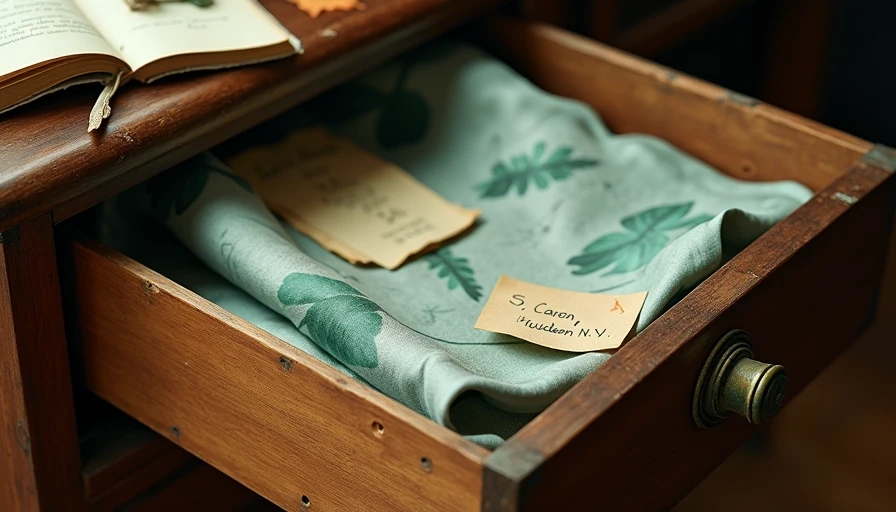
There is a silk scarf folded in the top drawer of my dresser, tucked between a stack of cotton bandanas and the wool scarf I wrote about in another essay, the rust-colored one that has accompanied me on approximately forty-three hikes and two minor emergencies. This silk scarf is different. This silk scarf is a mystery. Not in the dramatic, Agatha Christie sense — no one was murdered, there is no hidden fortune, the scarf itself is unremarkable in almost every way — but in the quieter, more persistent sense that I cannot, for the life of me, remember where I bought it.
This is not a small frustration. This is a splinter in my mind, a word on the tip of my tongue that has been there for three years. I know I bought the scarf on a Saturday in late September, because I wrote the date on a small tag and pinned it to the corner — September 24, 2023, per my own handwriting, which is a habit I started years ago to keep track of my secondhand finds. I know I was somewhere in the Hudson Valley, because the receipt was from a store whose name I can almost see, a blur of cursive letters on a cream-colored cardstock, an address that included the words "Main Street" and a zip code that started with 125. I know the scarf cost eleven dollars, because the number is burned into my memory in a way that the store name refuses to be. Eleven dollars. One crisp ten and a single, pulled from the pocket of my corduroy jacket, handed to a woman with silver hair who wrapped the scarf in tissue paper and said something I've now forgotten.
I have tried, multiple times, to reconstruct the day. I have consulted maps of the Hudson Valley, tracing the routes I might have taken. I have searched for vintage shops on Main Streets in towns whose names I think I remember — Rhinebeck? Red Hook? Hudson? Catskill? — and come up with nothing that matches the blur in my memory. I have Googled "vintage shop Main Street Hudson Valley closed" and "silk scarf eleven dollars September 2023" and other increasingly desperate combinations of keywords that have yielded exactly zero results. The town, the store, the woman with silver hair — they have all dissolved into the fog of my imperfect memory, leaving behind only the scarf itself, physical and real and stubbornly silent about its origins.
This essay has no satisfying resolution. I need to tell you that upfront, because I know how stories are supposed to work. The narrator sets out on a quest, overcomes obstacles, finds what she's looking for. But I have not found the town. I have not found the store. The mystery remains a mystery, and I am writing about it anyway, because I think there's something worth examining in the space between what we remember and what we don't, in the objects that outlast the experiences that brought them to us, in the strange way that a silk scarf can become more meaningful when its story is incomplete.
The Scarf, Described
Before I try to reconstruct the day — and I will try, I have notes, I have fragments — let me describe the scarf, because it's the only hard evidence I have, and it deserves a proper introduction.
It's silk. Real silk, the kind that slides through your fingers like water and catches the light in a way that polyester never can. The fabric is lightweight but dense, the weave tight enough that you can't see through it when it's folded. The edges are hand-rolled, which means someone — a person, not a machine — spent time on this scarf, rolling the silk between their fingers and stitching it into tiny, perfect hems. I know hand-rolled edges when I see them, because my mother taught me. She used to point them out at department stores, holding up scarves and turning them over to show me the difference between rolled and serged, between handmade and mass-produced, between something that took time and something that didn't.
The pattern is abstract, a watercolor blur of colors that don't quite resolve into shapes. There's green — the green of leaves seen through fog, soft and indistinct. There's blue, a gray-blue like the Hudson River on an overcast morning. There's a streak of something that might be pink or might be orange or might be the memory of a sunset, faded by time or by washing or by the simple fact of being old. The overall effect is of a landscape seen through rain-streaked glass, of something beautiful and just out of reach, which is, I realize, an almost painfully appropriate description for a scarf whose origins I can't remember.
The label is small and cream-colored, sewn into one corner with thread that matches the blue of the river. It reads "S. Caron" in a script that might be hand-embroidered or might be machine-stitched; I can't tell, and I've looked at it under a magnifying glass. Below the name, in smaller letters: "Hudson, N.Y." Hudson. The town of Hudson, New York, poplation approximately six thousand, home to antique shops and art galleries and a main street that I have walked up and down at least a dozen times in the past three years, scanning every storefront for something that sparks recognition.
I have been to Hudson, I know I have. But was it Hudson where I bought the scarf? The label says S. Caron, but S. Caron could have been the maker, not the seller. The scarf could have traveled from Hudson to wherever I bought it, passed from hand to hand, ending up in the shop of the silver-haired woman who wrapped it in tissue paper and said the thing I can't remember. The label is a clue, but it's not an answer. It's another thread in a web of threads I can't untangle.
The Day, Reconstructed from Fragments
Here is what I know about September 24, 2023, based on the contents of my phone and my journal and the handful of text messages I've never deleted:
I was in the Hudson Valley. That much is certain. I had driven up from Brooklyn the night before and stayed at a cheap motel whose name I also can't remember, but I know it had a neon sign that buzzed and a parking lot that was mostly empty. I had coffee at a diner where the waitress called me "hon" and the eggs were slightly overcooked and the toast was perfect. I had a map — a physical map, the kind that unfolds and never folds back the same way — with several towns circled in red pen. I was on a thrifting expedition, one of my early ones, still figuring out which towns had the best secondhand shops and which had been picked over by resellers and which were hiding treasures I hadn't yet discovered.
The first stop, according to a photo on my phone timestamped 9:47 AM, was an estate sale in a town called Germantown. I took a picture of a ceramic cat that I did not buy, and I still regret not buying it, because it was ugly in exactly the right way. The second stop was a church thrift shop in a town whose name I didn't photograph, where I bought a set of copper measuring cups for three dollars. The third stop was — and here the record gets fuzzy — somewhere on a Main Street, somewhere with a vintage clothing store, somewhere with a woman with silver hair.
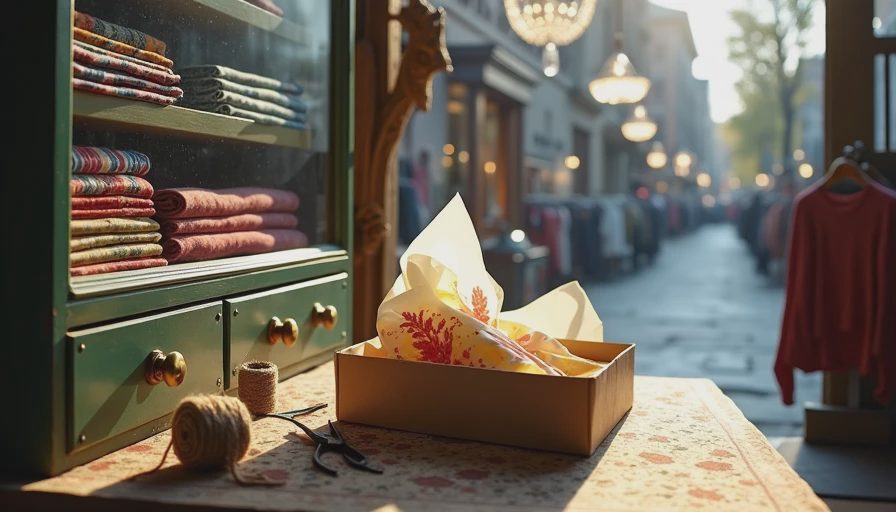
I remember the store itself in flashes, the way you remember a dream when you first wake up, before the details dissolve. It was small. It was cluttered in a way that felt curated rather than chaotic, which is the difference between a good vintage shop and a bad one. There were scarves in a glass-front cabinet, folded and stacked by color, and the cabinet had a brass handle that was tarnished in the shape of fingerprints. There was a Persian rug on the floor, worn thin in the middle, the colors faded to muted reds and blues. There was a chandelier that wasn't on, or maybe it was on, or maybe the light came from a window I can't remember.
The woman with silver hair told me something about the scarf. She told me something, and I wrote it down in my notebook — I know I did, because I have a notebook entry from that day that reads "scarf — $11 — S. Caron/Hudson — " and then a word I can't decipher, a word written in my own handwriting that might be "1950s" or might be "painted" or might be something else entirely, a word that has defeated me every time I've tried to read it. My handwriting is terrible under the best of circumstances. Under the circumstances of a long day of thrifting, scribbling notes while standing in a vintage shop, it's essentially a cipher.
The receipt, when I unfold it carefully from the tissue paper I've kept it wrapped in, is no help. The ink has faded. I can see the number 11.00 clearly, and the date, and something that might be a store name or might be a watermark. The paper is soft with age, or perhaps just soft with being folded and unfolded so many times, carried in my wallet and my pocket and my desk drawer, handled and examined and put away again.
The Attempts to Find It
I have made three dedicated trips to the Hudson Valley specifically to find the town where I bought the scarf, and all three have failed in different ways.
The first trip, in the spring of 2024, was optimistic and poorly planned. I drove up on a Saturday morning with a list of every Main Street vintage shop I could find online and visited eleven of them, one after another, in a frenzy of determination that eventually gave way to exhaustion. None of them were right. Some were close — a shop in Rhinebeck had a similar glass-front cabinet, a shop in Red Hook had a similar Persian rug — but none of them were the shop. I bought a pair of earrings in Red Hook and a denim jacket in Rhinebeck, because I am constitutionally incapable of leaving a thrift store empty-handed, but neither purchase brought me closer to the scarf's origin.
The second trip, in the summer of 2024, was more systematic. I had found a website that listed all the vintage shops in the Hudson Valley, and I had cross-referenced it with Google Maps and made a spreadsheet. I am not, by nature, a spreadsheet person, but the scarf had driven me to it. I visited stores in Hudson, in Catskill, in Saugerties, in Kingston. I showed a photo of the scarf to shop owners, who were universally helpful and universally unable to identify it. "That's a S. Caron," one of them said, "she was a textile artist in Hudson in the 1970s, but I don't know who would have been selling her work." A lead. A half-lead. A name and a decade and a town, but not a store, not the store, not the woman with silver hair.
The third trip, in the fall of 2024, was a deliberate return to the motel and the diner and the town of Germantown, trying to retrace my exact route from September 24, 2023. I found the motel — the neon sign was still buzzing — and I found the diner — the waitress was the same, and she still called me "hon" — and I found the house in Germantown where the estate sale had been, which was now someone's home again, the ceramic cat long gone. But the third stop, the vintage shop, the Main Street — I couldn't find it. I drove through towns whose names I knew and towns whose names I didn't, and none of them sparked the recognition I was looking for. It was as if the store had existed only for that one day, only for that one purchase, only for me.
After the third trip, I stopped looking. Not because I'd given up, exactly, but because I'd started to wonder whether finding the store would actually solve anything. The scarf had become more than a scarf. It had become a question, a puzzle, a small obsession that I carried with me. If I found the store, if I learned the name and the town and the thing the silver-haired woman had said — what then? The mystery would be solved, but the magic might be gone. And I had grown attached to the magic.
The Things We Forget, the Things We Keep
Memory is not a recording device. This is something I have learned the hard way, through years of trying to reconstruct the past from fragments and feelings and the unreliable archive of my own brain. Memory is a collage, a story we tell ourselves, a version of events that shifts every time we recall them. The scarf is real — I can hold it in my hands, touch the silk, trace the hand-rolled edges — but the day I bought it exists only in the versions I've reconstructed, each one slightly different from the last.
There is a theory in psychology called the "reminiscence bump" — the tendency for older adults to have increased recollection of events from adolescence and early adulthood. But I am not an older adult, and the scarf-buying was three years ago, not thirty. What I'm experiencing is something closer to the "doorway effect," the phenomenon where walking through a doorway makes you forget what you came into the room to do. The doorway, in this case, is time. I walked through three years, and the name of the town fell out of my head.
This happens more often than I'd like to admit. There is a necklace in my jewelry box from a street fair in a city I can't name. There is a ceramic mug in my kitchen cabinet from a pottery studio whose location I've lost. There is a book on my shelf with an inscription from someone whose signature I can't read, and whenever I open it, I spend a few minutes trying to remember who gave it to me and why. These objects are anchors without chains. They keep me tethered to moments I can't fully access, reminders that I was somewhere, did something, met someone, even if the details have faded.
I used to think this was a failure. I used to think that forgetting the town meant I wasn't paying enough attention, wasn't present enough, wasn't the kind of person who remembered the important things. But now I wonder if forgetting is just another way of curating — a mental decluttering, a Marie Kondo of the mind, letting go of the details that don't spark joy and holding onto the objects that do.
The scarf sparks joy. The story of the scarf sparks a different kind of joy, the joy of not knowing, the joy of a mystery that stays mysterious. I bought a silk scarf in a town I can't remember, from a woman with silver hair who said something I've forgotten, and the scarf is beautiful and the memory is incomplete and I have made peace with that.
What the Scarf Has Become
Three years after I bought it, the scarf has taken on a life of its own. I wear it regularly, draped around my neck or tied around the handle of my tote bag or folded into the pocket of my corduroy jacket. People compliment it. People ask where I got it. And I tell them, with the rueful honesty that has become my signature: "I bought it in a town I can't remember, from a woman with silver hair who told me something I've forgotten."
This answer is almost always met with confusion, and then amusement, and then the kind of curiosity that makes people ask follow-up questions. What do you mean you can't remember? How can you forget a whole town? Are you going to keep looking for it?
To that last question, I don't have a definitive answer. Part of me wants to find the store, to complete the story, to give the scarf the full biography it deserves. Part of me wants to leave it alone, to let the mystery remain a mystery, to let the scarf be defined by what I don't know rather than what I do. Both impulses are valid. Both impulses coexist, like the green and the blue and the maybe-pink of the scarf's abstract pattern.
What I do know is this: the scarf is mine now, regardless of where it came from. It has been folded in my dresser drawer, worn around my neck, draped over my shoulders at outdoor dinners and wrapped around my wrist at indoor ones. It has absorbed my perfume and my skin and my stories, even as it holds onto the story I can't access. It is a palimpsest, a garment with layers of history, some of which belong to me and some of which belong to the woman with silver hair and the artist named S. Caron and whoever owned it before them.
Maybe one day I'll be driving through the Hudson Valley, and I'll pass through a town I don't recognize, and I'll see a vintage shop on a Main Street with a glass-front cabinet and a Persian rug and a tarnished brass handle. Maybe I'll walk in, and the woman with silver hair will look up from behind the counter, and I'll say, "I bought a scarf here three years ago," and she'll say, "I remember you," and the mystery will be solved. Or maybe this will never happen. Maybe the store has closed. Maybe the woman has moved. Maybe the town has changed in ways that make it unrecognizable, even if I were standing in the middle of it.
Either way, the scarf remains. Soft and worn and beautiful and silent, holding its secrets close. I bought it for eleven dollars in a town whose name I've lost, and I will wear it until one of us falls apart.
Wear your story.