
The Estate Sale on 4th Street: A Woman's Wardrobe, 1972–2008
The sign was hand-lettered on a piece of cardboard and zip-tied to a parking meter: ESTATE SALE TODAY, with an arrow pointing toward a brownstone halfway down the block. I was not supposed to be on 4th Street. I was supposed to be on 5th Avenue picking up a birthday gift for my friend Marisol, who had specifically requested "something that doesn't look like it came from a thrift store, Chloe, I'm serious this time." But estate sale signs are to me what sirens were to sailors in Greek mythology, except instead of dashing my ship against the rocks, I dash my checking account against a pile of someone else's former belongings.
This particular brownstone was the kind that real estate listings describe as "full of original details" and everyone else describes as "hasn't been renovated since the Nixon administration." The front door was propped open with a brick. Inside, the house had that particular estate sale smell — a combination of old paper, cedar closets, and the faint ghost of decades of cooked meals. A woman in her forties sat at a card table near the entrance with a cash box and a stack of paper price tags. She had the weary look of someone who had been dealing with strangers touching her deceased relative's things since 7 AM.
"She was my aunt," the woman said, before I could ask. "Her name was Eleanor. Elly. She lived here for forty-three years. Everything must go by Sunday."
I asked if there was clothing. The niece — whose name I never learned, which feels like a failure on my part, but estate sales are strange, intimate, rushed things — pointed toward a staircase at the back of the hallway. "Second floor. Walk-in closet in the master bedroom. Fair warning: she kept everything."
She kept everything. Those three words should be engraved on my tombstone, because they are the words that reliably cause me to lose all sense of time and fiscal responsibility. I climbed the stairs two at a time.
The Closet
The master bedroom was already crowded with shoppers picking through jewelry boxes and nightstand drawers, but I walked straight past them toward the closet door, which was slightly ajar, a sliver of fabric visible through the crack. I pushed it open. And then I stopped moving, because what I saw required a moment of silence.
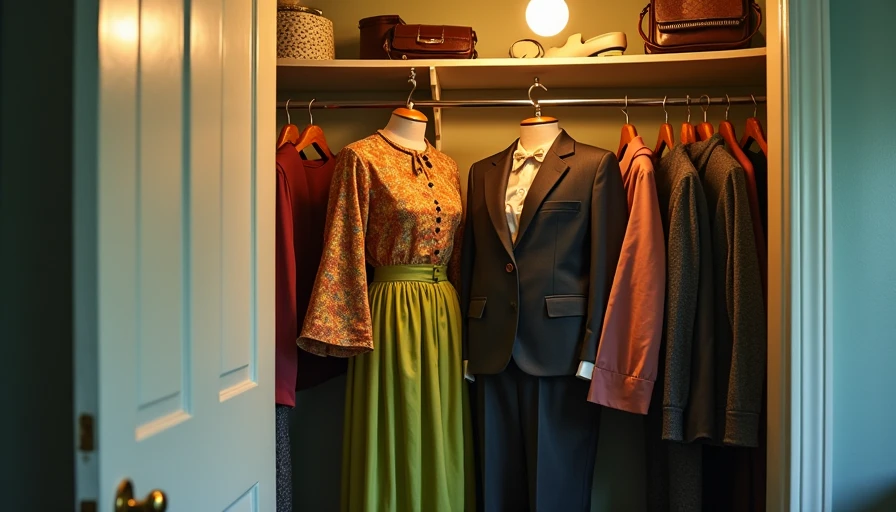
The closet was not a closet. The closet was a museum. A time capsule. A three-dimensional timeline of one woman's life as told through textiles, spanning from what I would later determine was approximately 1972 to 2008, when Eleanor presumably stopped buying new clothes, or stopped getting rid of old ones, or both.
The space itself was modest — maybe six feet wide, eight feet deep, with a single bare bulb hanging from the ceiling that cast everything in yellowish light. But the contents. The contents made my heart beat in a way that is usually reserved for romantic comedies and unexpectedly good pizza.
On the left side, dresses and blouses hung in chronological layers, like geological strata made of polyester and silk. The outermost layer was the oldest — early 1970s pieces with wide lapels and psychedelic prints and the particular synthetic sheen of fabric that was manufactured during the Nixon administration and will outlast human civilization. Buried deeper, newer pieces peeked through: the shoulder pads of the 1980s, the minimalist slip dresses of the 1990s, the occasional splash of early-2000s color that suggested Eleanor had briefly experimented with coral before deciding it wasn't for her.
The right side of the closet held coats and jackets, and this is where I nearly wept in public. A trench coat in exactly the shade of camel that fashion editors have been calling "timeless" for six decades. A black wool overcoat with a velvet collar that was worn but not worn out, cared for but not precious. A leather jacket from the 1970s with a label that read "Made in Florence" and was so soft it felt like butter had been turned into clothing. And in the very back, pushed aside as if it had been waiting for me specifically, a red coat.
Readers, I need you to understand about the red coat. It was the color of a fire truck, or a ripe cherry, or the kind of lipstick that requires confidence to pull off. Double-breasted. Gold buttons embossed with tiny anchors. A label inside that read "I. Magnin & Co." — a department store that closed in 1994, which meant this coat was at least thirty years old. The wool was dense and heavy in the way that modern wool rarely is, and when I tried it on over my sweater, it fit as if Eleanor and I had been built from the same blueprint.
I was not the only person in that closet. Other shoppers pushed past me, flipping through hangers, making small sounds of appreciation or dismissal. But I stood there in Eleanor's red coat, staring at the accumulated evidence of her forty-three years of getting dressed, and I felt something that I have felt at many estate sales but never quite this acutely: the overwhelming presence of a person who was no longer present. Eleanor was everywhere in this room — in the shoes lined up on the floor (size 7, mostly sensible, with a few pairs of heels that suggested she had been, at various points in her life, the kind of woman who danced), in the scarves folded in a drawer, in the handbags lined up on the top shelf. But Eleanor herself was gone, and all that remained was what she had worn.
The Archaeology of a Wardrobe
Here is what I learned about Eleanor from her closet, and I want to be clear that this is speculative archaeology, not documented fact. I never met Eleanor. I will never meet Eleanor. Everything I know about her is filtered through the lens of her clothing choices, which is an incomplete portrait but also, I would argue, a surprisingly intimate one. You can learn a great deal about a person from what they chose to put on their body every morning for four decades.
1972–1978: The Bold Years. The oldest garments in the closet were the loudest. A polyester blouse with a geometric print in orange and brown, the kind of pattern that could induce vertigo if stared at too long. A maxi dress in lime green with bell sleeves. A halter top in a fabric that I can only describe as "astronaut chic." Eleanor, in her early twenties according to the timeline I was constructing, had been a woman who was not afraid of color or pattern or the particular synthetic revolution that was happening in textile manufacturing. She had been bold. She had been experimental. She had worn things that demanded to be noticed.
1979–1986: The Power Years. Something shifted around 1979. The closet's chronology told a clear story: Eleanor had entered the workforce, and her clothing had sharpened accordingly. Shoulder pads appeared, modest at first and then increasingly aggressive. Skirt suits in navy and charcoal. Silk blouses with bow ties at the neck, the uniform of women who were breaking into rooms that had previously been closed to them. A single pair of white pumps that looked like they had been worn exactly once, probably to an event where Eleanor needed to project authority despite footwear that was fundamentally impractical.
I found a suit in this section that stopped me cold. It was a blazer and skirt set in charcoal gray wool, with a label from a tailor in Midtown Manhattan. The blazer was fully lined. The skirt was hemmed to exactly knee-length. And stitched inside the blazer's interior pocket was a small tag, clearly added after purchase, that read: "E. Vasquez." Eleanor had been important enough to warrant custom labels in her work clothes. Eleanor had been someone.
1987–1995: The Softening. The shoulder pads began to shrink. The colors shifted from power neutrals to something gentler — dusty rose, sage green, a lavender cardigan that was still soft to the touch thirty years later. A collection of silk scarves appeared, each one rolled and stored in a drawer, suggesting that Eleanor had entered a phase of accessorizing with intention. There were evening dresses in this section too, slips of velvet and silk that implied parties, dates, events that required more than a suit. Eleanor had had a life after work. Eleanor had gone places.
1996–2008: The Comfort Years. The final section of the closet was the smallest but, in many ways, the most moving. The fabrics shifted to natural fibers — cotton, linen, wool. The cuts became looser, more forgiving, less interested in impressing anyone. A collection of Eileen Fisher pieces appeared, their elegant simplicity a stark contrast to the geometric prints of the 1970s. A drawer full of cotton turtlenecks in every neutral shade. A pair of driving moccasins, the kind of shoe that prioritizes comfort over fashion, and in doing so achieves its own kind of elegance.
This section told me that Eleanor, in her later years, had stopped performing. She had figured out what she liked to wear — soft fabrics, simple shapes, nothing too constricting — and she had committed to it. The experimental phase was over. The power phase was over. What remained was something quieter, more assured, the wardrobe of a woman who knew exactly who she was and didn't need to prove it to anyone.
The Objects Between the Clothes
A closet holds more than clothes. Between the garments, tucked into corners and drawers and the spaces on the top shelf that required a step stool to reach, I found the detritus of a life.
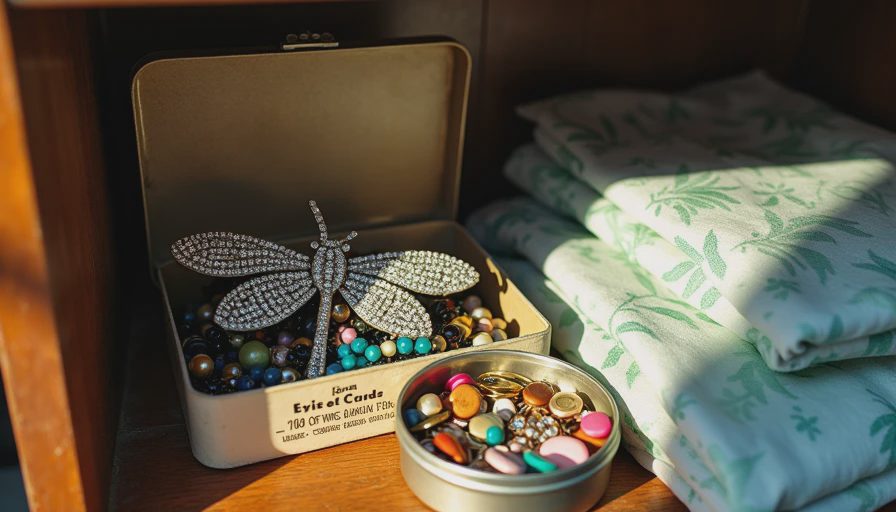
A shoe box labeled "Holiday Cards 1987" containing exactly zero holiday cards and instead holding a collection of costume jewelry — chunky necklaces, clip-on earrings, a single brooch shaped like a dragonfly with rhinestone wings. A small tin that had once held butter cookies and now held buttons, dozens of them, the spare buttons that come with new garments and are immediately forgotten. Eleanor had kept every single one. A folded piece of paper tucked into the pocket of a winter coat, which I unfolded with trembling fingers and discovered was a shopping list from 1994: milk, bread, coffee, dry cleaning, call Margaret re: Saturday. Margaret. The name from the estate sale in Poughkeepsie, where I'd found the wedding dress. For a wild moment I wondered if it was the same Margaret, if the universe was connecting these women's stories through me, but of course it probably wasn't, and even if it was, I would never know.
In the bottom drawer of a built-in dresser, beneath a stack of cashmere sweaters, I found a photograph. It was black and white, slightly curled at the edges, the emulsion cracked in places. It showed a young woman — Eleanor, I assumed, though I couldn't be certain — standing on a city street in a dress that I immediately recognized. It was the lime green maxi dress with the bell sleeves, the one still hanging in the closet. She was wearing it with a wide-brimmed hat and platform sandals, and she was laughing at something outside the frame. The photograph was dated on the back in neat handwriting: "June 1973, outside my first apartment."
I held the photograph and looked at the dress, still hanging there, still impossibly green, and I felt time fold in on itself. The dress had been in this photograph. The dress had been worn by this laughing, hat-wearing, platform-sandal-having woman in 1973. And now, fifty-three years later, the dress was in my hands, and Eleanor was gone, and I was standing in her bedroom trying to figure out what to do with the weight of all this history.
Estate sales are not really about shopping. I know I write about them as if they are, I know I make jokes about finding cashmere for four dollars and feeling like I've committed a minor crime. But underneath the bargain hunting, underneath the thrill of discovery, there is this: the encounter with mortality. The confrontation with the fact that every person who has ever lived has accumulated things, and those things will outlast them, and someday a stranger will stand in your closet and try to reconstruct your life from the scraps you left behind.
What I Took Home
I am not made of stone. I bought things.
The red coat, obviously. It was priced at fifteen dollars, which felt like a clerical error but the niece confirmed it when I asked. "Everything has to go," she said again, and her voice had that flat quality of someone who has been saying the same sentence for two days and has lost all emotional connection to it. "Fifteen dollars. You want it?"
I wanted it. I also bought the camel trench coat, because I am only human and the trench coat cost eight dollars and fit me like it had been tailored to my body by a very precise and moderately priced Italian artisan. I bought the dragonfly brooch with the rhinestone wings. I bought the tin of spare buttons, because some day I would need a button and I would be grateful to Eleanor's memory. I bought a silk scarf with a pattern of tiny ferns that matched nothing in my wardrobe and somehow matched everything. I bought one of the cotton turtlenecks from the Comfort Years because it was the color of oatmeal and so soft it felt like wearing a hug from someone who really meant it.
Total spent: forty-three dollars. Forty-three dollars for a coat that will last another thirty years, a trench coat that makes me feel like a character in a film I'd actually want to watch, a brooch, a scarf, a sweater, and two hundred buttons. The mathematics of estate sales are absurd. The emotional mathematics are even more so.
As I was paying, I asked the niece what Eleanor did for a living. "She was an editor," the niece said. "At a publishing house in the city. Retired in 2000. Never married, no kids. Just her books and her clothes and her cat."
Eleanor had been an editor. Eleanor had worked with words. Eleanor had lived alone in this brownstone with books and clothing and a cat, and I have never felt more kinship with a stranger in my entire life. I looked down at the red coat folded over my arm and felt, for a moment, that I hadn't just bought it — I had inherited it. I had been chosen. Eleanor, wherever she was, would approve.
The Red Coat's New Life
That was six months ago. The red coat is now my coat. Not in the transactional sense, not in the "I paid fifteen dollars and now it belongs to me" sense, but in the deeper sense that I wrote about in another essay, the sense that clothing absorbs the wearer and the wearer absorbs the clothing. I have worn the coat to dinner parties and farmers markets and first dates and once, memorably, to a job interview where the interviewer spent the first five minutes asking me where I got it.
I always tell people the truth. "It was Eleanor's coat," I say. "She was an editor. She lived on 4th Street for forty-three years. She had excellent taste in outerwear." And then I show them the label, the I. Magnin & Co. tag that dates the coat to before 1994, and I tell them about the closet time machine, about the lime green maxi dress and the shoulder pads and the cashmere turtlenecks, about the buttons in the butter cookie tin and the photograph from June 1973.
Sometimes, when I'm wearing the coat, I think about Eleanor Vasquez. I think about her walking into that publishing house in her charcoal power suit, the one with the custom label inside. I think about her coming home to this brownstone, hanging the suit back in the closet, putting on one of her silk evening dresses for whatever event she had that night. I think about her in the 1990s, softening into dusty roses and sage greens. I think about her in the 2000s, retired, wearing her Eileen Fisher and her driving moccasins, running errands in the neighborhood she'd lived in for four decades. I think about her cat, the one she had at the end, the one who probably sat on the cashmere sweaters and shed fur all over the wool coats.
I never knew Eleanor. I will never know Eleanor. But I know her clothes, and I'm taking care of them, and maybe that's a kind of knowing. Maybe that's the closest any of us get to immortality — not living forever, but leaving behind objects that someone else will find, will hold, will wear, will tell stories about.
The estate sale on 4th Street was supposed to last through Sunday. By Saturday afternoon, when I walked past the brownstone again out of curiosity, the sign was gone. The house was empty. A real estate agent's lockbox hung on the front door. The closet that had held forty-three years of a woman's life was bare, and Eleanor's clothes were scattered across the city, carried home in the shopping bags of strangers. The lime green maxi dress went to someone. The power suits went to someone. The lavender cardigan went to someone. A hundred different people were now walking around New York in Eleanor Vasquez's clothes, and none of them knew each other, and none of them would ever know the full story of the woman who had worn them first.
But I have the red coat. And every time I put it on, I try to wear it the way I imagine Eleanor wore it: with confidence, with presence, with the understanding that a truly good garment is not just an object but a companion. Thank you, Eleanor. I hope I'm doing your coat justice.
Wear your story.