The Most Beautiful Outfit I've Ever Seen Wasn't Mine
Let me tell you about a stranger I saw on the subway three years ago, because apparently I am the kind of person who holds onto subway encounters for three years and then writes entire essays about them. This is my life now. I have made peace with it.
It was a Tuesday morning in late September, around 8:45 AM, which is to say it was the worst possible time to be on the Q train heading toward Manhattan. The car was packed with the usual morning crowd: people in business casual clinging to overhead handles, teenagers with headphones the size of earmuffs, a man eating a breakfast burrito in a way that suggested he had given up on social contracts entirely. I was wedged between a woman with a stroller and a man reading a newspaper — an actual physical newspaper, which in 2023 felt like seeing a dinosaur in the wild — and I was in a bad mood because I had spilled coffee on my shirt approximately four minutes before boarding and was now conducting a strategic scarf-arrangement operation to hide the stain.
And then I saw her.
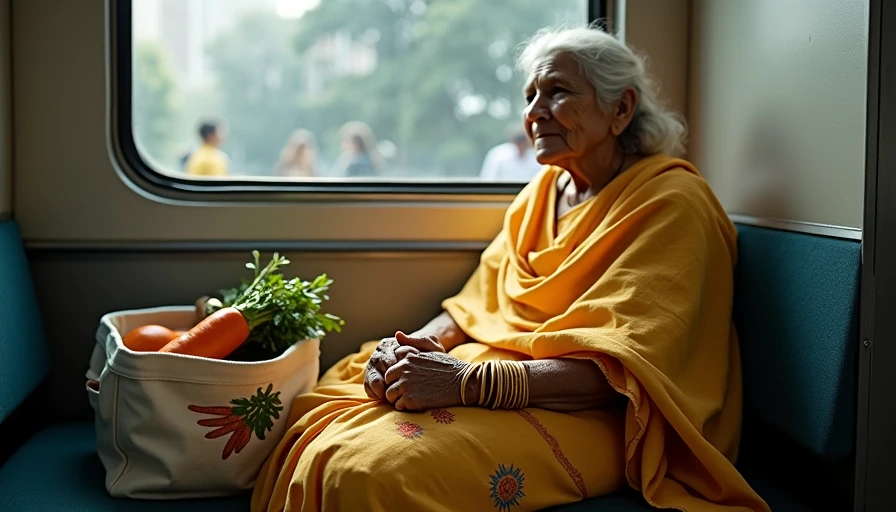
She was sitting in one of the corner seats reserved for elderly and disabled riders, which she qualified for on both counts. She was probably in her late seventies, possibly early eighties, with silver hair pulled back into a low bun that had clearly been done by hands that had been doing that exact bun for decades. Her face was lined in the way that suggests a life spent smiling and squinting into sunlight and frowning at things that deserved to be frowned at. She had a canvas shopping cart parked between her knees, the kind with two wheels and a floral pattern, and it was filled with what looked like vegetables from a farmers market — I could see the green tops of carrots poking out, the round edge of an eggplant, something wrapped in brown paper that might have been cheese.
But what stopped me, what made me forget about my coffee stain and my bad mood and the man with the burrito, was what she was wearing.
She had on a saree. Not a formal saree, not the kind you'd wear to a wedding or a Diwali celebration. This was an everyday saree, a working saree, faded in that particular way that cotton fades after hundreds of washes — the color had once been a deep marigold, I think, but had softened over time into something closer to the color of butter, or late afternoon sunlight, or the inside of a peach. The border was a darker gold, almost bronze, and the pallu — the end piece draped over her shoulder — had tiny embroidered flowers that were barely visible anymore, worn down by years of shoulders and hands and wind and weather. Underneath the saree, she wore a long-sleeved blouse in a completely different shade of green, a soft sage that didn't match the saree at all and somehow matched it perfectly.
On her feet: sensible sandals. On her wrists: a stack of gold bangles that clinked softly every time she moved, which was rare, because she was sitting perfectly still, hands folded in her lap, watching the subway car with the calm expression of someone who has seen everything and is no longer surprised by any of it.
She was the most beautiful person I had ever seen. And I don't mean beautiful in the way fashion magazines mean it — not young, not trendy, not airbrushed into some impossible ideal. I mean beautiful in the way that a tree is beautiful, or a river, or a building that has stood for a hundred years and will stand for a hundred more. She was beautiful because she was completely, utterly herself. Nothing about her outfit was trying to impress anyone. Nothing was new. Nothing was expensive. Everything had been worn and washed and worn again, and in that process, it had become something more than clothing. It had become a record of a life.
The Question That Wouldn't Leave Me Alone
I got off the train at Canal Street. She stayed on. I watched her through the window as the train pulled away, and she was still sitting there, still calm, still radiating that quiet, devastating elegance. I walked up the stairs to the street and I could not stop thinking about her saree, her bangles, the green tops of her carrots, the way the morning light had caught the faded gold border and made it look like something from a painting.
And here is the thought that arrived, fully formed, and has refused to leave me for three years: I have never looked that beautiful in anything. Not in my most expensive dress. Not in the outfit I spent three weeks planning for my friend's wedding. Not in the carefully curated "effortless Brooklyn casual" looks I assemble for brunches and farmers markets and first dates. I have never once, in my entire life, achieved the kind of beauty that woman achieved on a Tuesday morning on the Q train in a faded cotton saree she probably bought twenty years ago.
Why?
That question has been chewing on me for three years. I've turned it over and over in my mind like a stone in my pocket, looking for the smooth spots, the places where the answer might reveal itself. And after a lot of thinking — and a lot of observing, and a lot of standing in front of my closet feeling vaguely dissatisfied with everything I owned — I think I've found it. Or at least, I've found a version of it that I can articulate.
The woman on the train was beautiful because her clothes belonged to her. Not in the legal sense, not in the "she paid for them" sense, but in a deeper sense. Her clothes were not performing. They were not trying to signal anything about her income or her taste or her awareness of current trends. They were not curated to look good in photographs. They were just her clothes, worn by her body, in her life, for however many years she had been wearing them. The saree had faded because she had washed it hundreds of times. The embroidery had worn away because she had draped the pallu over her shoulder hundreds of times. The bangles were stacked the way they were because she had put them on in the same order, one by one, every morning for decades.
This is the opposite of how most of us interact with our clothing. I know it's the opposite of how I interact with mine. I buy things, and I wear them for a while, and then I get bored or they go out of style or I convince myself they don't look good on me anymore, and I donate them and buy something new. Or I buy things that look good on Instagram but feel wrong on my actual body, in my actual apartment, in my actual life. Or I keep things in my closet for years but never quite feel at home in them, never quite settle into them the way that woman had settled into her saree.
She wasn't wearing clothes. She was wearing herself. And that, I now believe, is the entire secret.
The Problem with How We Dress Now
I need to pause here and say something that might sound like a complaint about modern fashion, but it's not — or at least, it's not only that. It's an observation about a shift that has happened so gradually most of us didn't notice it.
We are living in an era of unprecedented clothing consumption. The average American buys sixty-eight garments per year, which is roughly one new item every five days. Most of these garments are worn fewer than seven times before being discarded or donated or buried in the back of the closet. The fashion industry produces over one hundred billion garments annually, and a significant percentage of them are designed to be worn for a single season and then thrown away.
The numbers are staggering, but the emotional reality is worse. Because when you're constantly cycling through new clothes — when nothing in your closet has been there for more than a year or two — you never develop a relationship with your garments. They never get a chance to soften and fade and mold themselves to your body. They never absorb your stories. They're just visitors, passing through, and you're just a waystation between the store and the landfill.
The woman on the train had probably owned that saree for twenty years. Maybe thirty. Every wash had softened the cotton a little more. Every wear had taught the fabric something about the shape of her shoulders, the way she moved, the way she sat on subway trains and walked through markets and cooked dinner in her kitchen. The saree wasn't just a garment anymore. It was part of her. And that's why it looked so beautiful — because it was inseparable from the person wearing it.
I thought about my own closet. The sweaters I'd bought on impulse and never wore. The dresses that looked perfect on the mannequin and all wrong on me. The jeans I kept because they'd fit someday, maybe, if I changed in some fundamental way. How many of my clothes actually belonged to me the way that saree belonged to her? How many of them had been in my life long enough to earn that belonging?
The answer was uncomfortable. But it was also clarifying.
The Experiment
A few months after the train encounter, I decided to try something. It wasn't a formal experiment, just a quiet shift in how I approached my closet. I called it, in my head, "the belonging project," and then immediately felt embarrassed about calling it that, which is why I'm telling you now but never told anyone else.
The rules were simple:
One: Stop buying things that don't feel immediately, instinctively right. Not "this will look good after I alter it" or "this is trendy right now" or "this was on sale." Only buy things that feel like they could belong to me for a very long time.
Two: Wear the things I already own more often. Stop treating clothes as precious or delicate or "too nice for everyday." The saree had been worn to the farmers market on a Tuesday morning. Elegance doesn't require a special occasion.
Three: Let things show their age. Stop throwing away sweaters because they had a small hole. Stop retiring shirts because the color had faded. The fading was the point. The wear was the point. The evidence of a life was the point.
Four: Pay attention to the people around me who had achieved the kind of beauty I was chasing. What were they wearing? How old was it? How did they move in it? What could I learn from them?
The experiment wasn't perfect. I still bought things I didn't need. I still got seduced by sales and trends and the particular dopamine hit of a new package arriving in the mail. But slowly, over months and then years, something started to change. I started to feel differently about the clothes I kept. I started to look forward to the moment when my favorite sweater would develop a small hole, because mending it would make it more mine. I started to notice the fading and the softening and the wearing as signs of love rather than signs of decay. I started to understand, in a visceral way, that beauty and newness are not the same thing — that in fact, they are often opposites.
The People I Started Noticing
Once I started looking, I saw them everywhere. Not on Instagram, not in magazines, not on the carefully styled pages of fashion blogs. But in real life. On the subway. At the grocery store. Walking down the street in my neighborhood.
There was the old man at the bodega on my corner who wore the same gray cardigan every single day, summer and winter, and had clearly been wearing it for so long it had become part of his silhouette. The cardigan was pilled and stretched out at the elbows and missing a button, and he looked more dignified than any man in a bespoke suit I've ever seen.
There was the woman at the laundromat folding a stack of cotton housedresses, each one faded to a different pastel shade — pink that used to be red, blue that used to be navy, yellow that used to be gold. She folded them with quick, practiced movements and stacked them in a wicker basket, and the whole scene looked like a painting by an artist who understood something about domestic life that I was only beginning to grasp.
There was the teenage girl on the bus wearing a leather jacket that was clearly too big for her, clearly inherited, clearly from another decade. The jacket had patches on the sleeves and a tear near the pocket that had been repaired with visible stitching, and she wore it like armor, like protection, like a reminder that she came from somewhere and belonged to someone.
None of these people were dressed in a way that would attract attention on social media. None of them were wearing anything new, or expensive, or intentionally fashionable. But all of them were beautiful in exactly the way the woman on the train was beautiful. Their clothes had become them. They had worn their garments long enough and hard enough that the boundary between person and clothing had started to dissolve.
This is not a beauty that can be bought. It can only be accumulated, over time, through the simple act of wearing things and keeping them and wearing them again. It's a slow beauty. A patient beauty. A beauty that doesn't announce itself but is unmistakable once you learn to see it.
What Fast Fashion Takes from Us
I want to be careful here, because I don't believe in lecturing people about where they shop. Clothing budgets are real. Size accessibility is real. The ability to participate in trends is not a moral failing. I am not here to make anyone feel guilty about buying things they can afford and enjoy.
But I do think it's worth naming what fast fashion — and the broader culture of disposable clothing — has taken from us. It's taken the experience of growing old with our clothes. It's taken the gradual softening of cotton over dozens of washes, the mending and the patching and the re-buttoning, the way a garment becomes more beautiful as it becomes less perfect. It's taken the stories that accumulate when you wear something for years instead of months — the coffee stain from the morning you got the call about the job, the frayed hem from dragging on the sidewalk during a long walk home, the worn spot on the shoulder where your bag always rests.
These are not damages. These are not flaws. These are the physical evidence of a life lived in clothes, and they are precious precisely because they cannot be manufactured or faked. You can't artificially distress a garment and get the same effect. A machine cannot replicate the particular way a favorite sweater pills after three winters of wear. Factory fading cannot match the gradual bleaching of a cotton shirt by actual sunlight, in an actual garden, on an actual afternoon.
When everything in your closet is new, nothing in your closet has a story. And a closet without stories is just a storage unit. It's not a wardrobe. It's certainly not a self.
Relearning How to Belong to Our Clothes
The woman on the train taught me that the most beautiful outfit I've ever seen wasn't beautiful because of its design, or its brand, or its cost. It was beautiful because of time. Because the woman and the saree had spent so many years together that they had become a single thing — not a person and her clothing, but a person-in-her-clothing, a complete and indivisible self.
I am still learning how to do this. I am still learning how to buy things that are meant to last, how to care for them so they do last, how to wear them through multiple seasons and multiple versions of myself. I am still learning how to resist the pull of newness, the seduction of trends, the constant whisper that says "you would be happier if you just bought this one thing."
But I am getting better. I have sweaters now that I've owned for five years, six years, seven years. I have a corduroy jacket that has survived three apartments and a breakup, and it looks better now than it did when I bought it. I have my mother's winter coat, which is older than I am and still keeps me warm through every Brooklyn winter. These are the garments I reach for when I want to feel like myself. These are the garments that make me feel beautiful, not because they are perfect, but because they are mine.
The woman on the Q train is probably still out there somewhere, wearing her faded saree to the farmers market, stacking her gold bangles one by one every morning, being effortlessly, devastatingly beautiful without trying at all. She will never know she was the subject of an essay. She will never know that a stranger on the train has been thinking about her outfit for three years. But I hope, somehow, that she would understand why. I hope she would look at her faded cotton and her mismatched blouse and her sensible sandals and say, "Yes, of course. This is how it's supposed to be."
Because it is. This is how it's supposed to be. Clothes are not meant to be consumed and discarded. They are meant to be worn, and worn, and worn some more. They are meant to soften and fade and tear and get mended. They are meant to become so much a part of us that we stop seeing them as separate things — "my outfit," "my clothes," "my style" — and start feeling them as extensions of ourselves, as natural and unselfconscious as our own skin.
The most beautiful outfit I've ever seen wasn't mine. But maybe someday, if I keep wearing the same corduroy jacket long enough, if I keep patching my mother's coat and stacking my bracelets the same way every morning, something in my closet will get close. Not identical — I will never wear a faded marigold saree on the Q train — but kin to it. Belonging to the same family of beauty. The family of things that have been loved for a very long time.
Wear your story.