On Wearing the Same Dress to Three Weddings
Here is a sentence that makes some people visibly uncomfortable: I wore the same dress to three weddings in one year, and no one noticed.
I want to pause here and let that sink in, because I know what some of you are thinking. You're thinking: three weddings? Same dress? What if the guests overlapped? What if the photos got posted online? What if someone recognized it and judged you for repeating an outfit? These are legitimate questions in a culture that has somehow convinced us that garments are single-use items, that formalwear is a consumable resource, that the worst sin a woman can commit at a wedding is looking like she's worn something before.
But here is what actually happened. I wore a burgundy silk wrap dress to my cousin Elena's wedding in June, to my college roommate's wedding in September, and to my friend from book club's wedding in December. I styled it differently each time. I felt beautiful each time. The photographs are lovely. No one pulled me aside and said, "I saw that dress on Instagram three months ago." No one revoked my fashion license. The world continued to spin on its axis. And I saved myself approximately four hundred dollars and thirty hours of online shopping, which I instead spent on wedding gifts and dance floor participation and actually enjoying the celebrations instead of stressing about what I was going to wear to them.
This essay is about that dress and those weddings. But it's also about the quiet rebellion of repeating outfits — the radical act of wearing something more than once, of refusing the pressure to constantly acquire, of treating your clothes as companions rather than disposables. It's about the question I get asked whenever I tell this story: "But weren't you bored? Didn't you want something new?" And it's about my answer, which is: no. I wasn't bored. I was free.
The Dress, Described
Before I tell you about the weddings, I need to tell you about the dress, because it matters that it was this particular dress and not just any garment I pulled from my closet. The dress was, and is, a thing of beauty in a way that has nothing to do with trends and everything to do with the kind of craftsmanship that makes me believe in objects.
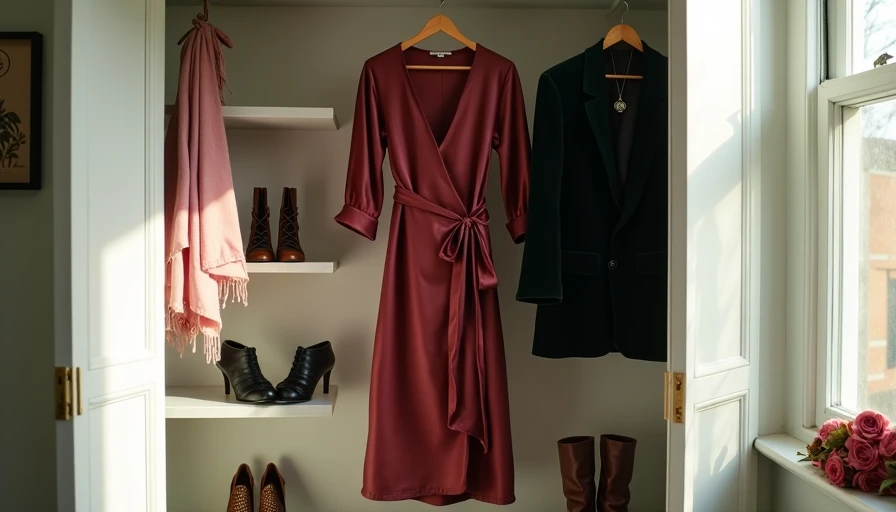
I found it at a consignment shop in Park Slope three years ago, tucked between a rack of bedazzled mother-of-the-bride gowns and a collection of 1990s prom dresses that had not aged well. It was priced at forty-five dollars, which felt like a typo. The fabric is silk charmeuse — real silk, the kind that feels cool to the touch and shifts color slightly when it moves, catching the light in different ways. The color is burgundy, but not a flat burgundy, more like the color of a very good wine held up to a candle, deep and complex and slightly different every time you look at it. The cut is a wrap dress, which means it ties at the waist and can be adjusted to fit almost any body, a feature that has proven useful over the years as my weight has fluctuated and my shape has shifted. Wrap dresses, I have learned, forgive you for not being the exact same size you were three years ago.
The dress has a V-neck that is deep enough to feel elegant but not so deep that I spend the entire evening checking it. The sleeves are three-quarter length, a detail I love because it covers the part of my arms I'm most self-conscious about while still showing my wrists and hands. The skirt falls to mid-calf, which is long enough to be formal but short enough to dance in. There is a hidden interior button at the wrap point that keeps everything secure, the kind of detail that someone thought about, the kind of detail that makes a garment last.
When I tried it on in the consignment shop's cramped changing room — really just a closet with a shower curtain instead of a door — I looked at myself in the mirror and felt something I rarely feel when shopping: satisfaction. Not excitement, not the brief high of acquisition, but the deeper, calmer feeling of having found something that was exactly right. The dress fit me. The dress looked like me. The dress felt like it had been waiting in that consignment shop for the exact moment I walked in.
Wedding Number One: The June Garden Wedding
My cousin Elena got married in June at a botanical garden in Connecticut, which is exactly as lovely as it sounds. The ceremony was in a rose garden. The reception was in a greenhouse. There were string lights and peonies and more varieties of roses than I could identify. The dress code on the invitation said "garden party formal," which is one of those wedding dress codes that sounds specific but is actually a trap. What does "garden party formal" mean? Nobody knows. Everyone pretends they know. I have attended enough weddings now to understand that wedding dress codes are approximate guidelines rather than actual rules, and the sooner you accept this, the happier you'll be.
For this wedding, I leaned into the garden theme. I wore the burgundy dress with a pair of nude sandals that I've owned for so long I don't remember buying them, the kind of sandals that go with everything and make your legs look longer without being uncomfortable. I added a vintage floral silk scarf — pink and cream, with roses that echoed the actual roses in the garden — tied around my shoulders in the evening when the temperature dropped. I wore small gold hoop earrings that belonged to my grandmother, delicate and simple and just right. My hair was loose, with a single braid pinned back on one side.
The dress moved beautifully in the garden light. The burgundy silk looked almost red in the direct sun and almost brown in the shade, shifting and changing as I walked from ceremony to cocktail hour to dinner. The wrap waist meant I could adjust it — slightly looser after the dinner, slightly tighter before dancing — without anyone noticing. I felt comfortable. I felt elegant. I felt like myself.
During the reception, my aunt — Elena's mother — pulled me aside and asked where I'd bought the dress. I told her the truth: consignment shop, forty-five dollars, probably from the late 1990s based on the label. She raised her eyebrows and said, "Well, you look like a million dollars," which is the correct response to learning that someone has found an incredible deal. I thanked her and did not tell her that I planned to wear the same dress to another wedding in three months, because that particular fact felt like it would complicate the moment.
Wedding Number Two: The September City Wedding
The second wedding was my college roommate Cara's, held at a converted warehouse event space in Brooklyn, which is exactly the kind of wedding you have when you've lived in New York for a decade and have accepted that "rustic industrial" is as close to nature as you're going to get. The dress code was "cocktail attire," which is slightly more straightforward than "garden party formal" but still leaves plenty of room for error. Cara, who is one of the most stylish people I know, had told me privately that she wanted people to "look like themselves, but shinier." I understood exactly what she meant.
This time, I styled the burgundy dress differently. Completely differently. If the garden wedding version of this outfit was romantic and floral, the city wedding version was sharp and architectural. I wore the dress with a fitted black blazer — another thrift find, a Theory piece that I'd scored for thirty dollars at a Housing Works sale — over my shoulders like a cape. I added strappy black heels instead of the nude sandals, the kind of heels that make a satisfying sound on concrete floors. My jewelry was silver instead of gold: a geometric necklace from a maker in Queens, clean lines and sharp angles. My hair was up, twisted into a low bun with deliberate, sleek precision.
When I walked into the venue, Cara hugged me and said, "You look incredible, I love that dress." She did not say, "Didn't you wear that to Elena's wedding?" Because she hadn't been at Elena's wedding. But also because she was a normal person who understood that dresses are meant to be worn more than once.
The warehouse space was all exposed brick and Edison bulbs and a DJ who played excellent 90s R&B. I danced for three hours. The wrap dress stayed in place. The hidden interior button did its job. The silk breathed in a way that polyester never does, keeping me cool despite the crowd and the dancing and the general overheating that occurs when you're in your thirties and attempting to do the running man. At the end of the night, my feet hurt but my dress was pristine, and I felt deeply, quietly satisfied with my decision to rewear something instead of buying something new.
Wedding Number Three: The December Holiday Wedding
The third wedding was my friend Rachel's, a former book club member who had moved to Vermont but came back to New York for a December ceremony at a historic inn in Hudson. The dress code was "festive formal," and the date was December 18th, which meant the wedding was essentially a Christmas party with vows attached. There was a sleigh. There was hot mulled wine. There were approximately seventeen different kinds of evergreen arrangements, and I am not exaggerating about that number.
This was the biggest styling challenge, because wearing the same burgundy silk dress to a summer garden wedding and a winter holiday wedding seemed, on the surface, impossible. Burgundy is a fall color, sure, but could it go full holiday? Could it handle sleighs and mulled wine and the general pressure of December festivity?
The answer was yes. The answer was velvet.
I layered a forest green velvet blazer over the dress — the kind of blazer that looks like it belongs on a Victorian poet or a very stylish librarian, which are two aesthetics I am always chasing. The combination of burgundy silk and dark green velvet felt richly wintery, like walking through an evergreen forest at dusk. Gold jewelry this time: a vintage gold locket I found at an estate sale in Rhinebeck, heavy gold earrings, a gold bangle that had belonged to my mother's mother. Black boots instead of heels — my Red Wings, the ones I've written about, the ones that have survived mountains and creeks and now, apparently, formal weddings. They were clean, at least. Largely clean. Clean-adjacent.
The inn was lit with candles and firelight. The burgundy silk caught the flames and shimmered in a way that felt almost magical, almost intentional, almost like I had planned the whole thing from the beginning. People complimented my dress. People asked where I got it. I told them the truth — consignment shop, three years ago — and every single person said some version of "that's incredible" or "I wish I could find things like that." No one said, "isn't that the dress you wore to Cara's wedding?" No one said, "why are you wearing the same dress again?" Because normal people, in real life, do not track other people's outfits the way we fear they do.
What I Learned: The Case for Repeating Outfits
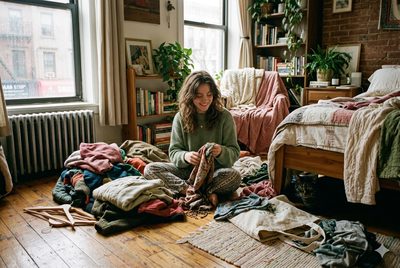
After the third wedding, sitting at my kitchen counter at midnight with a cup of tea I didn't need and Hemingway the cat purring on my feet, I did some math. A new wedding guest dress, if you're buying from a mid-range retailer, costs somewhere between one hundred and three hundred dollars. That's not even considering the more expensive options. Three weddings, three new dresses: three hundred to nine hundred dollars, before you add shoes or accessories or alterations or the dry cleaning afterward.
But the money, surprisingly, was not the most important thing I saved. The most important thing was time. The hours I did not spend scrolling through online stores, comparing options, reading reviews, ordering multiple sizes, trying things on, returning what didn't work, starting the whole process over again. Every wedding I didn't shop for saved me somewhere between five and fifteen hours of mental energy. Over three weddings, that's an entire weekend or more — time I spent reading, writing, hiking, seeing friends, actually living my life instead of shopping for it.
The environmental cost matters too. I don't want to be preachy about it, but the numbers are hard to ignore. The fashion industry is responsible for more carbon emissions than international flights and maritime shipping combined. A single dress worn once and then abandoned in the back of a closet represents a chain of resources — water, energy, labor, shipping — that ends in a landfill or a donation bin. My burgundy dress, worn three times and counting, is a tiny act of resistance against that system. It's not fixing climate change. I know that. But it's something. It's a choice I can make and keep making.
But the biggest thing I learned, the thing that surprised me most, was this: repeating the same dress didn't make the weddings less special. It made the dress more special. Every time I wore it, the burgundy silk absorbed a new layer of memory. Elena's rose garden wedding. Cara's warehouse dance party. Rachel's Christmas sleigh wedding. Three celebrations of love, three groups of people I care about, three nights of joy and dancing and champagne — and one dress, tying them all together like a thread through my year.

The dress is not just a dress anymore. It's an archive. It's a record of a year in my life, of the people I love getting married, of the dancing and the toasting and the moments in between. That's worth more to me than any new purchase could be.
The Rules I Made Up (And Then Broke)
Before this year, I had absorbed a set of unwritten rules about wedding guest attire, rules I had never examined but had somehow internalized anyway. The dress must be new. The dress must not have been worn to a previous wedding, especially if any of the same guests might be present. The dress must photograph well. The dress must not upstage the bride but must still look good enough to prove that you tried. The dress must be appropriate for the season, the venue, the dress code, the time of day, the geographic region, the astrological alignment, and probably several other factors I'm forgetting.
These rules were invented by the fashion industry. They were perpetuated by magazines and social media and the general culture of constant consumption that benefits from making women feel like they don't have enough, aren't enough, haven't done enough. The rules serve a purpose, and that purpose is profit. The rules are not real.
Wearing the same dress to three weddings required breaking all of them, and breaking them felt like stepping out of a cage I hadn't realized I was in. The first time, I was nervous. The second time, I was curious. The third time, I was triumphant. By the time Rachel's December wedding rolled around, the burgundy dress felt like an old friend — familiar and reliable and somehow more beautiful for having been worn before.
I'm not saying I'll never buy another dress for a wedding. I probably will. I'm human; I like new things; there will be weddings in the future where the burgundy doesn't feel right or the season demands something lighter or I genuinely want the experience of finding something new. But now I know that "needing" a new dress for every event is a choice, not a necessity. It's a pressure I can opt out of whenever I want. And knowing that has changed how I think about every piece of clothing I own.
In Defense of the Uniform
There's a concept in fashion that I've been thinking about a lot lately: the uniform. The idea that some people — stylish people, famously well-dressed people — wear essentially the same thing every day. Steve Jobs and his black turtlenecks. Carolina Herrera and her white button-downs. Georgia O'Keeffe and her black dresses, the ones she wore for decades, the ones that became so associated with her that you can't imagine her in anything else.
The uniform is often described as a limitation, a narrowing of options, a way of reducing decision fatigue. And that's true. But I think it's also something else. I think the uniform is a form of self-knowledge. It's saying: I know what I like. I know what works on my body. I don't need to keep searching, because I've already found it.
My burgundy silk wrap dress is not, literally, a uniform. I don't wear it every day. But it's become something like a uniform for special occasions — the thing I reach for when I need to feel beautiful and I don't want to think about it. Having that option, having a garment that I can rely on, is a kind of luxury that new purchases can't replicate. It's the luxury of knowing. It's the luxury of being done.
What I Hope You Take from This
If you're reading this and you love buying new formalwear, if the excitement of a new dress for every event is something that genuinely brings you joy, I'm not here to take that away from you. Fashion should be joyful. Getting dressed should be joyful. I'm not the police of anyone's closet but my own.
But if you're reading this and you've ever felt the pressure — the expectation that you need to show up to every event in something new, the anxiety of not having anything to wear, the credit card bill after a wedding season that left your bank account gasping — I want you to know that there's another way. You can rewear things. You can restyle things. You can treat your clothes like resources instead of liabilities, companions instead of single-use items.
You can wear the same dress to three weddings. You can wear it to four, or five, or as many as you get invited to before the dress literally falls apart and needs to be replaced. No one will judge you. And even if they do — even if someone does notice and does, for some reason, decide to be weird about it — their judgment says more about their relationship with clothing than yours.
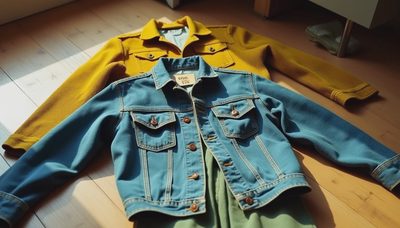
My burgundy dress is hanging in my closet right now, cleaned and pressed after Rachel's December wedding, waiting for the next invitation. There's a wedding in May that I'm attending — a former coworker, a ceremony in a barn in the Hudson Valley, the dress code TBD but probably some variation on "rustic chic." I'm planning to wear the burgundy dress. I'm thinking gold jewelry again, maybe flat sandals if the weather's warm, maybe a denim jacket over it at the reception if the evening gets cool. It'll be version four of the same garment, and I'm already excited to see what memories this next layer adds.
Because that's the thing about wearing something more than once: the garment doesn't lose value. It gains it. Every wedding adds to its history. Every wear deepens its story. My burgundy silk wrap dress, bought for forty-five dollars in a consignment shop, is now one of the most valuable things I own — not because of what it cost, but because of what it's witnessed.
Wear your story.